Testing blood is a helpful way to understand specific aspects of immune activity and metabolism. Minimally, it’s useful to have markers for blood group (needed for Oligoscan), red blood cell (RBC) and white blood cell (WBC) counts, comprehensive metabolic panel (CMP) and lipids, LDH isoenzymes, iron studies (iron, transferrin, transferrin saturation %, ferritin), thyroid markers (TSH, fT3, fT4), vitamin B6 and vitamin D (inactive form). Your doctor is usually the best person to assist you with these, however private lab services are also available in many countries, should these be helpful.
In the disease model, elevated serum vitamin B6, vitamin A and LDL are all potential proxy markers for hepatic ALDH2 inhibition, via NAD+:NADH redox impairment, downstream of oxidative stress and mitochondrial Complex I inhibition, indicating mitochondrial dysfunction. LDL is the most reliable, as it's less impacted by dietary input patterns. Serum vitamin B6 elevation is also influenced by Zn and Mg-ATP insufficiency, inhibiting pyridoxal kinase.
Impaired hepatic mitochondrial function can be expected to affect gluconeogenesis, retinol -> retinal -> retinoic acid metabolism and a range of other important pathways.
Similarly, insufficient thyroid vs insulin signalling can also inhibit gluconeogenesis at PEPCK. Thyroid hormone synthesis is influenced by tyrosine, iodine, selenium and electrolytes / ATPase activity. Iodide transporters (NIS) require retinoic acid signalling. Selenium status is affected by silver and mercury toxicity.
USA 1
DirtCheapLabs.xyz have kindly created a custom panel which includes all of the markers above, currently via Quest -
https://dirtcheaplabs.xyz/c/joshua-leisk/bornfree-life-standard-set
(again, a clear reminder that I intentionally do NOT receive any income or benefits from any lab test or supplement vendors)
USA 2
Australia
Lactate dehydrogenase (LDH) isoenzymes
Lactate dehydrogenase (LDH) is an enzyme primarily involved in converting pyruvate to lactate (and vice versa). It has five isoenzymes (LDH-1 to LDH-5), each consisting of different combinations of two subunits: H (heart) and M (muscle). Further, there are individual LDH isoforms - LDH-A/B/C which make up these isoenzymes. These isoforms have specific roles / functions. LDH is also a metalloenzyme, affected by zinc status and NAD+:NADH ratio. LDH isoenzymes are distributed across various tissues based on their metabolic needs.
The terms "H" (heart) and "M" (muscle) subunits were historically named based on the tissues where these subunits were first observed in high concentrations. The H (heart) subunit was first identified in cardiac tissue, which relies on aerobic metabolism. The M (muscle) subunit was discovered in skeletal muscle, which often utilises anaerobic glycolysis, especially during high activity.
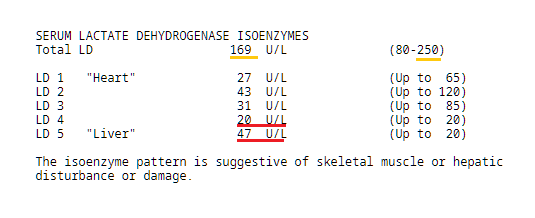
This test allows you to see if an elevation of a specific isoenzyme or pattern of elevations is present, further suggesting if a particular tissue is experiencing energy metabolism dysregulation, and/or upstream influences affecting energy metabolism.
eg. If LDH-4 and LDH-5 (which contain more M subunits, characteristic of anaerobic glycolysis) are elevated, it can be indicative of reduced oxygen availability or prolyl hydroxylase inhibition for other reasons (oxidative stress, low Fe/Si, low Zn, low alpha-ketoglutarate, elevated succinate). These isoenzymes are more prevalent in tissues that rely on anaerobic metabolism, such as skeletal muscle and liver, and their elevation suggests a shift towards lactate production due to reduced oxygen, a common feature of hypoxic conditions and / or various issues which inhibit prolyl hydroxylase activity (see Figure 1).
Standard LDH testing only measures TOTAL LDH. The individual isoenzymes are combined into a single figure, easily obscuring any anomalies in an individual tissue. This makes standard LDH testing highly unreliable and easily provides another false negative result, upsetting diagnostics efforts by clinicians.
eg.