
Bulk mineral ingredients
These are candidate sources for individual minerals. Product details were last checked on 30 September 2026. Some concentrations still require written confirmation from the supplier.
Before preparing a formulation: best practices would be to obtain a current, lot-specific certificate of analysis (CoA). Confirm identity, elemental concentration, carriers, suitability for human consumption, contaminants and expiry. A product name, SKU or historic certificate does not establish the composition of the batch supplied.
The calculations below check the proposed quantities only. They do not establish suitable daily doses or support taking the same dose for a year. A clinician should review the need for each mineral, total intake, medicines and monitoring. A pharmacist should assess weighing accuracy, blend uniformity, compatibility and stability before any bulk preparation. Household scoops and unvalidated home blending are unsuitable for trace-mineral dosing. Keep all powders labelled and secured away from children.
Silica
Silica is a highly essential nutrient and a little more complicated than others, as it plays different roles depending on the form.
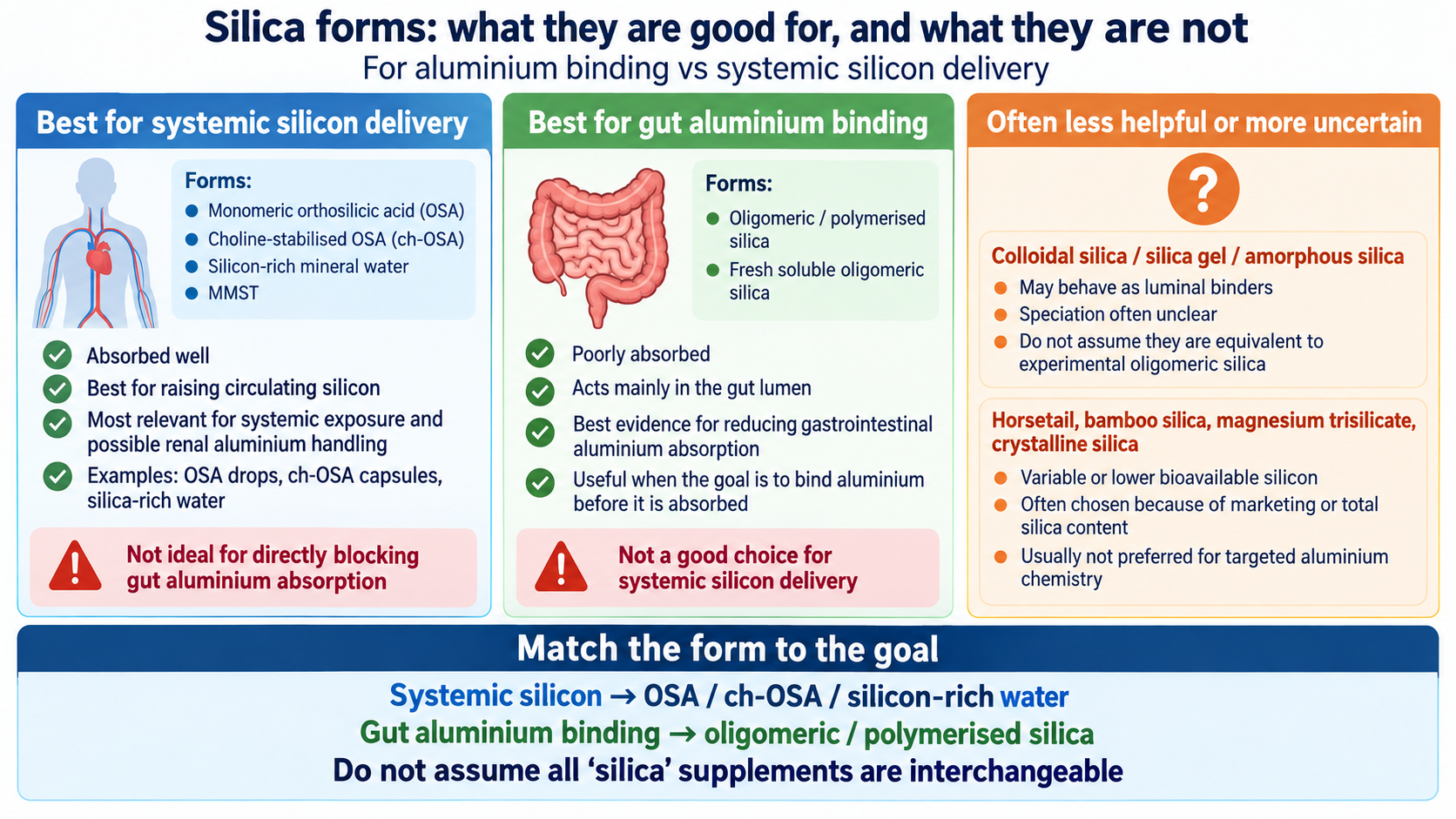
Oligomeric silica very poorly absorbs, only slightly converts into a monomeric form that does absorb, however is useful for removing aluminium, acetaldehyde and various toxins from the gut.
Monomeric silica absorbs well and helps systemic repletion - which is sacrificed for aluminium and acetaldehyde, etc. removal, but these forms of silica tend to be unusually expensive to source.
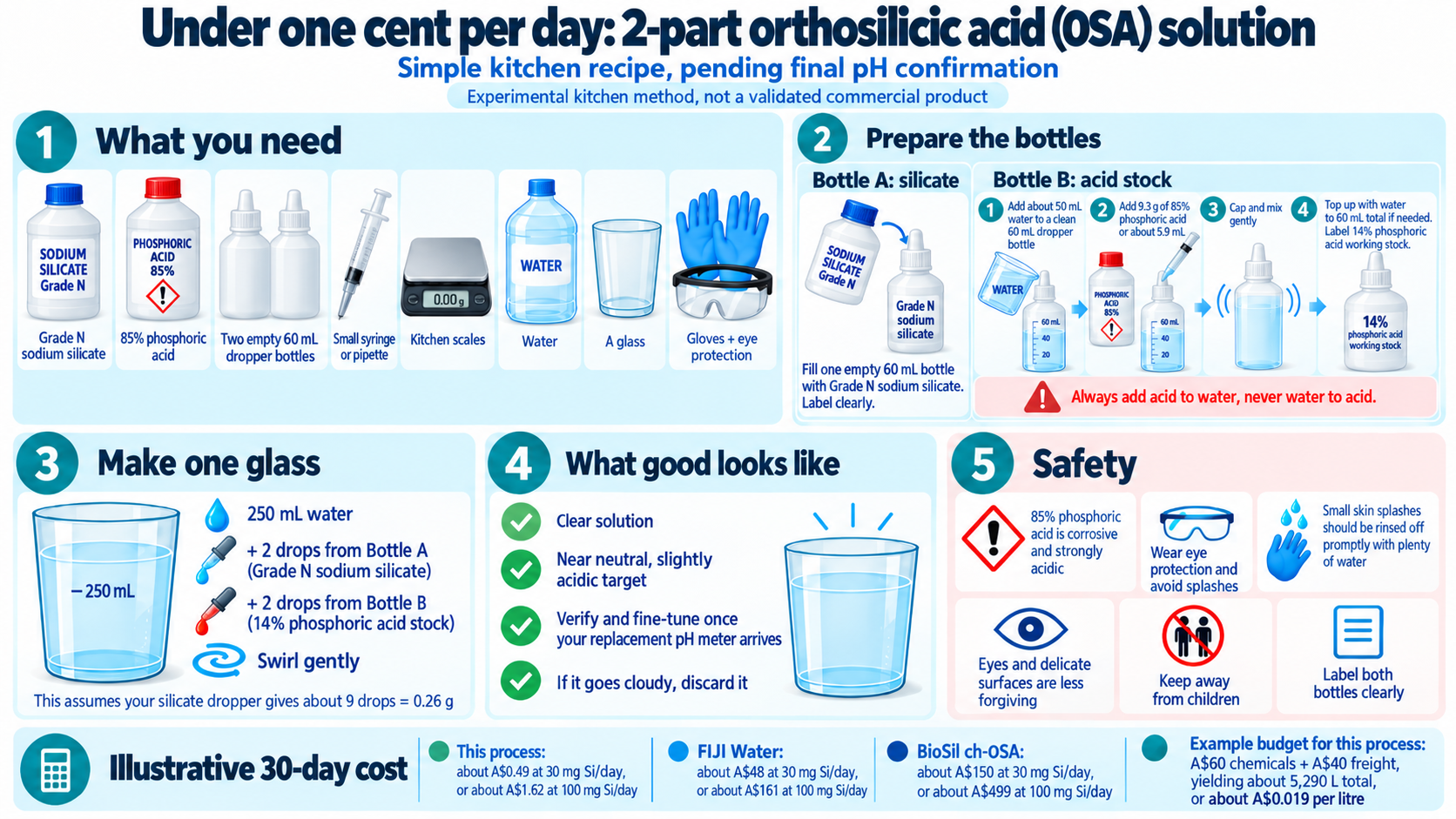
This recipe requires empty bottles and tools obtained as part of the protocol, plus N-grade sodium silicate and phosphoric acid.
USA:
https://ceramicsupplyusa.com/product/sodium-silicate-liquid-n-pint/
https://www.amazon.com/dp/B06Y1B82TG/
AU/NZ:
https://www.ccg.co.nz/craft/product/161/sodium-silicate-grade-n-liquid
https://www.amazon.com.au/85-Phosphoric-Acid-1L-Orthophosphoric/dp/B0CBTMJLSJ/
Copper
Candidate source: BoxNutra copper gluconate. The supplier describes it as water-soluble and lists 100 g and 500 g packs. The proposed 14% elemental copper concentration is consistent with SKU COP014S, but an elemental assay was not found in the product description.
Conditional calculation: at 14% copper, the protocol's typical 5 mg elemental amount, where indicated, corresponds to 35.7 mg powder. Using the unrounded daily mass gives a 365-day equivalent of 13.04 g. These figures remain provisional until the assay is confirmed.
Alternative: the supplied copper-chelate link currently identifies copper bisglycinate chelate at 26%. This is a different product and cannot be substituted by powder weight.
A chelated copper supplement supplies copper; it is not a treatment for removing excess copper. Copper supplementation requires particular care in Wilson's disease or liver disease. See NIH copper guidance.
Iron
Candidate source: BoxNutra ferrous gluconate, listed in 100 g and 500 g packs. The proposed 11% elemental iron concentration is suggested by SKU FER011S, but still needs a lot-specific assay.
Conditional calculation: at 11% iron, the protocol's typical 30 mg elemental amount, where indicated, corresponds to 272.7 mg powder and 99.55 g over 365 days. A 100 g pack leaves only about 0.45 g before handling losses. A 500 g pack provides more material, but is not a reason to continue treatment beyond the assessed need or expiry.
Iron should be guided by clinically interpreted iron studies and follow-up. It is unsuitable for people with iron overload unless specifically directed by their clinician. It can also interfere with some medicines. Accidental ingestion can be fatal in children. See NIH iron guidance.
Manganese
Candidate source, grade confirmation required: BoxNutra manganese amino acid chelate 20%. The title states 20%, but the description also refers to foliar and soil application. Obtain written confirmation of suitability for human consumption, the complete formulation and a current CoA before considering this product.
Conditional calculation: at 20% manganese, the protocol's typical 1 mg elemental amount, where indicated, corresponds to 5 mg powder and 1.825 g over 365 days. The listed 100 g pack is substantially larger than this amount. Accurately distributing such a small quantity requires a validated preparation method; geometric dilution alone does not prove blend uniformity.
Excess manganese can cause neurological harm. Chronic liver disease can reduce its elimination. See NIH manganese guidance.
Chromium
Candidate source, assay unresolved: BoxNutra chromium amino acid chelate, listed in 100 g and 500 g packs. SKU CHR2.5S suggests 2.5%, but this is not an assay. The certificate linked from the supplier's library does not report elemental chromium concentration. Confirm trivalent chromium identity and the concentration in the supplied batch.
Conditional calculation: only if 2.5% is confirmed, the protocol's typical 1.5 mg (1,500 micrograms) elemental amount, where indicated, corresponds to 60 mg powder and 21.9 g over 365 days.
The absence of an established upper intake level does not demonstrate safety at this dose. Chromium can increase hypoglycaemia risk with insulin or other glucose-lowering medicines; kidney and liver disease require particular caution. See NIH chromium guidance.
Vanadium
Candidate source, clinical suitability unresolved: BoxNutra vanadium chelate 1%, listed in 100 g and 500 g packs. The title states 1%; the specific chelate chemistry and lot-specific elemental assay still need confirmation.
Arithmetic check only: at 1% vanadium, the protocol's typical 1 mg elemental amount, where indicated, corresponds to 100 mg powder and 36.5 g over 365 days.
This does not validate a daily regimen. EFSA could not establish safe use of the vanadium sources it assessed for foods and supplements. The assessment does not verify this particular product.
Zinc
Candidate source: BoxNutra zinc gluconate 12%, listed in 100 g and 500 g packs. At the labelled 12%, the protocol's daily 60 mg elemental amount corresponds to 500 mg powder and 182.5 g over 365 days. A 500 g pack covers that arithmetic quantity, subject to expiry and actual requirements.
Alternative: BoxNutra zinc citrate. SKU ZNC031S suggests 31%, but this needs assay confirmation. Do not substitute citrate for gluconate by powder weight. Solubility and suspension behaviour in the intended formulation also need checking.
The protocol's typical 60 mg/day, where indicated, exceeds the US adult upper intake level of 40 mg/day from all sources. Doses of 50 mg/day or more taken for weeks can impair copper absorption, if not accommodated by dose timing or route.
Adding copper does not, by itself, establish that a high-zinc regimen is safe. Higher therapeutic doses require medical supervision and review. See NIH zinc guidance.
Selenium
Candidate source, elemental assay unresolved: BoxNutra selenium as L-selenomethionine, listed in 100 g and 500 g packs. SKU SLS0.5S suggesting 0.5% elemental selenium. The library certificate for lot FCWZ21B001 names L-(+)-selenomethionine 1.25% in a blend - typically dicalcium phosphate is used as filler.
The protocol typically uses 0.5 mg (500 micrograms) per day of elemental selenium, where indicated.
This proposed amount exceeds the US adult upper intake level of 400 micrograms/day and the EFSA adult upper level of 255 micrograms/day, before food and other supplements are counted.
Selenium errors can cause serious toxicity; include dietary and other supplemental sources in the assessment. See NIH selenium guidance.
Molybdenum
Candidate source: BoxNutra molybdenum amino acid chelate 0.1%. The title states 0.1%, equivalent to 1 mg elemental molybdenum per gram of powder, subject to lot confirmation. Packs include 100 g and 500 g.
Conditional calculation: at 0.1% elemental molybdenum, the proposed 0.5 mg (500 micrograms) daily target corresponds to 500 mg powder and a 365-day equivalent of 182.5 g.
The US adult upper intake level is 2,000 micrograms/day from all sources; this is a limit, not a target. See NIH molybdenum guidance.
Iodine
Candidate source: BoxNutra iodine from potassium iodide, listed in 100 g and 500 g packs. Confirm purity, carriers and elemental iodine concentration. Potassium iodide mass is not the same as iodine mass. Lugols iodine is another common source.
The protocol's typical 2 mg (2,000 micrograms) per day may be insufficient for extreme deficiencies. Clinician review may suggest 50-100mg elemental doses as appropriate. Iodine content of potassium iodide is 76.45%.
This proposed amount exceeds the US adult upper intake level of 1,100 micrograms/day, before food and other supplements are counted. Use above this level requires individual medical supervision.
Do not use radiation-emergency potassium iodide doses as nutritional guidance. Excess iodine can cause either reduced or increased thyroid activity, particularly in susceptible people. Thyroid disease and relevant medicines require clinician review. See NIH iodine guidance.
Lithium
Candidate source, elemental assay unresolved: BoxNutra lithium orotate, listed in 100 g and 500 g packs. The product description does not establish elemental lithium concentration. Elemental lithium content of lithium orotate is typically 3.9%.
The protocol typically uses 5 mg per day, where indicated. This is elemental lithium, not 5 mg of lithium orotate.
Lithium orotate should not be substituted for prescribed lithium. Ask a pharmacist or clinician to review use, especially with kidney or thyroid disease, dehydration or interacting medicines.
NHS lithium interaction guidance concerns prescribed lithium; it does not establish the safety of a lithium-orotate supplement regimen.
Boron
Candidate source: BoxNutra boron glycinate 5%. The supplier explicitly states 5% elemental boron, equivalent to 50 mg boron per gram of powder, subject to lot confirmation. Packs include 100 g and 500 g.
Conditional calculation: at 5% elemental boron, a proposed 20 mg daily target corresponds to 400 mg powder and a 365-day equivalent of 146 g.
The proposed supplement alone reaches the US adult upper intake level of 20 mg/day; boron from food or other supplements would take total intake above it. This requires individual clinical review and is not a routine daily recommendation.
The US adult upper intake level is 20 mg/day from all sources; this is not a recommended dose. See NIH boron guidance.
Strontium
Unresolved source: BoxNutra strontium citrate. The listing was sold out when checked, including the 100 g and 500 g variants. No alternative supplier, elemental assay, daily target or batch quantity has been validated. This remains an open item.